The
Conversation Indian Industry Is Not Having Enough
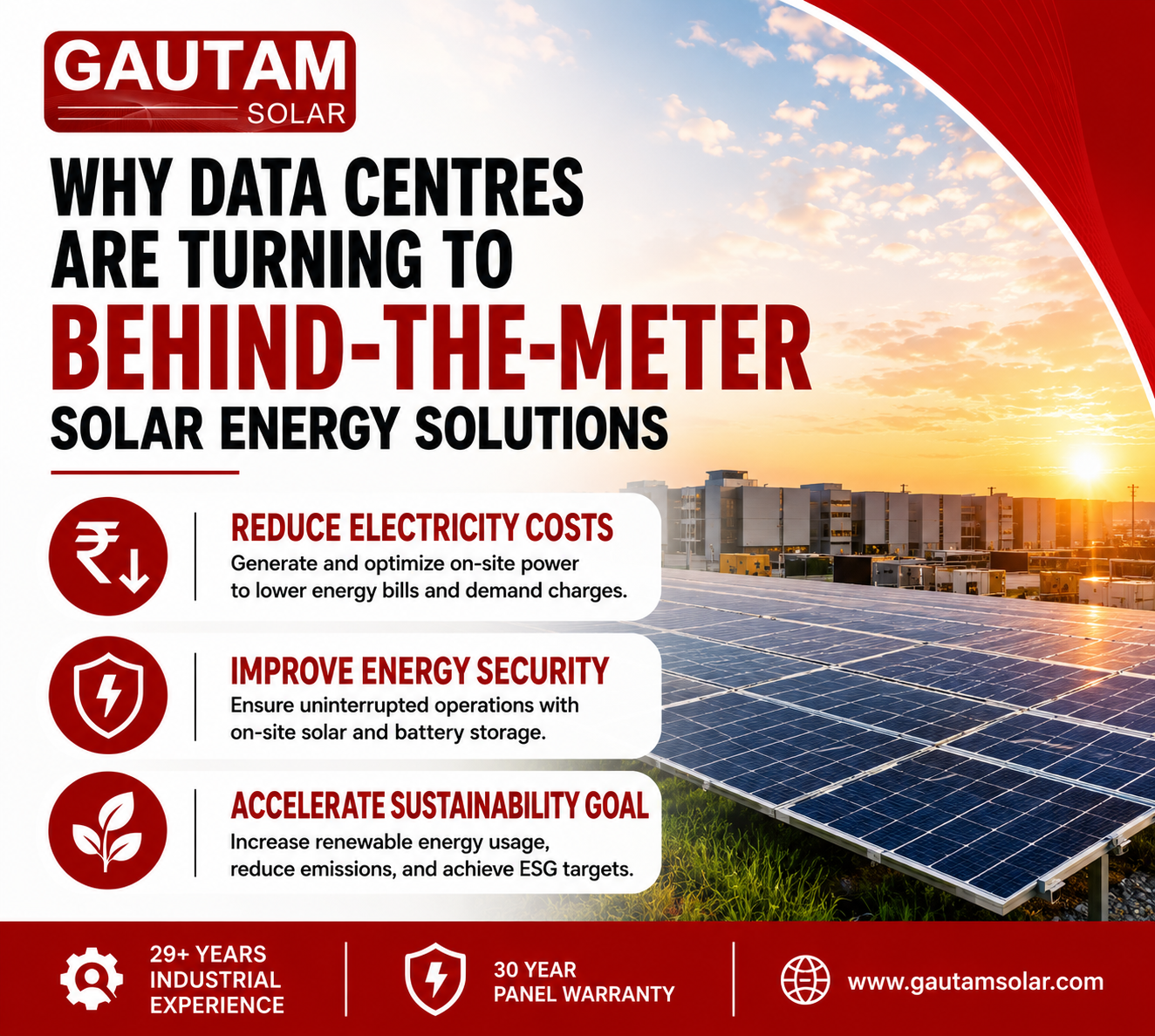
Every business in India that is commercial or industrial is talking about electricity costs. Most conversations are one thing. The cost per unit of electricity. Few people discuss where the chance to save. The real chance to save is with Behind the Meter solutions. For industrial consumers with facilities over 1 MW understanding Behind the Meter solutions can mean the difference between reducing energy costs by 70%. This is not a sales pitch for a product. It is a way to think clearly about energy infrastructure at your site. What it is, how it works and how much it can save. It also looks at what technology choices will make the savings work, over 20 to 25 years. Commercial and Industrial businesses should think about their energy costs and Behind the Meter solutions to save more on electricity.
What
"Behind the Meter" Actually Means
Every commercial and industrial facility has a utility meter that has been installed by the DISCOM in order to measure the amount of electricity being drawn from the grid by the facility.
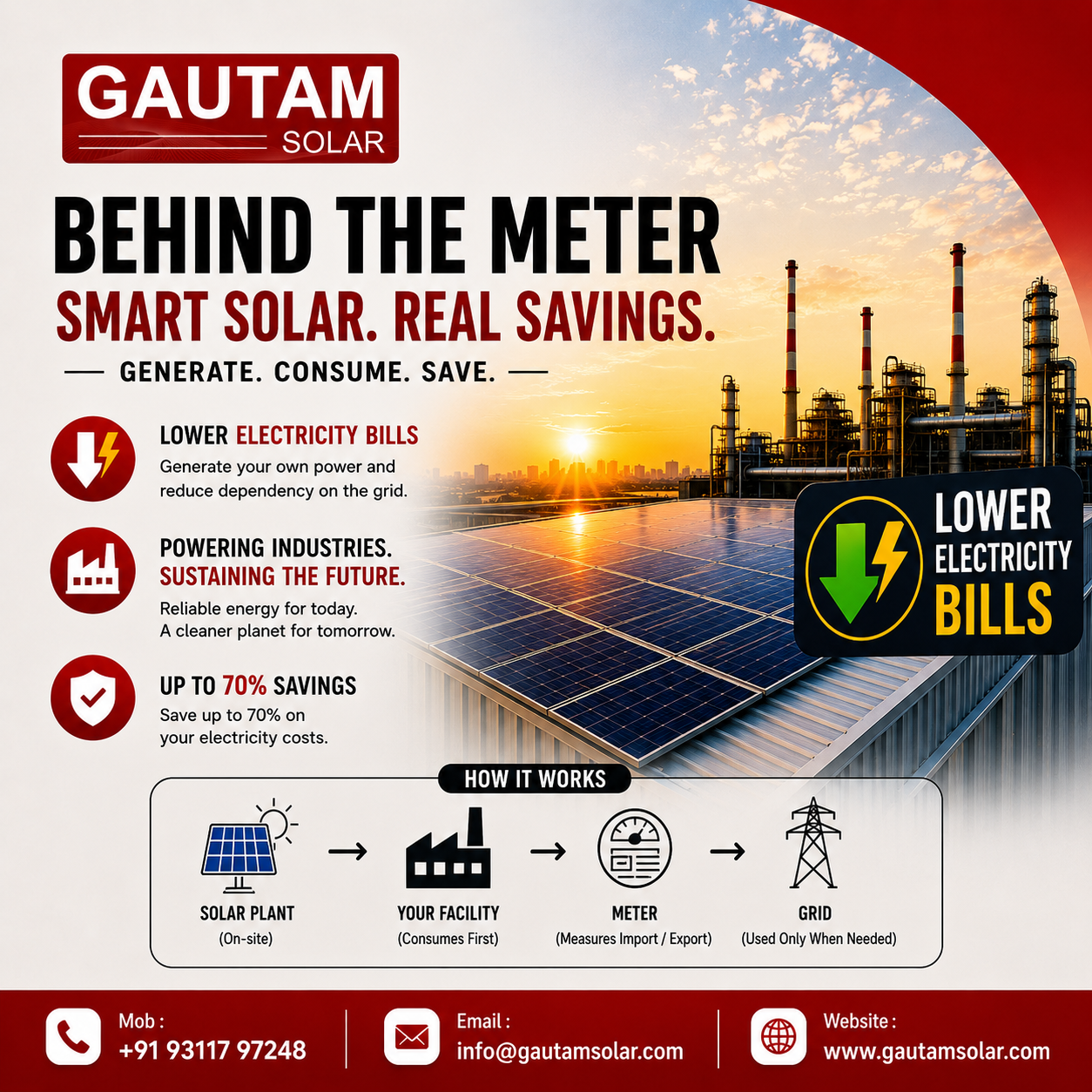
Behind the Meter is a term used to describe everything behind this boundary. An energy system which is installed behind the utility meter – either on the roof of the facility, in adjacent land or even inside the plant, which produces and stores electricity for direct use on site is referred to as a Behind the Meter system. The electricity produced is consumed directly at the loads and never reaches the meter. The DISCOM will not be aware of this electricity generation system, and hence will not bill for it, nor will it be wheeled.
Front of the Meter is everything before the meter including the grid, the power stations, and utility scale projects. For instance, when the C&I consumes electricity from an open access solar power plant located somewhere else in the same state, electricity is delivered via the grid, through the meter and then billed.
That is a Front of the Meter transaction — even if the power is from renewable energy.
The distinction matters because Behind the
Meter energy avoids several categories of charges that Front of the Meter
energy cannot: wheeling charges, transmission charges, Cross Subsidy Surcharge,
and increasingly, the Grid Support Charges and electricity duties that states
like Maharashtra are now levying on solar consumers.
Why
Commercial and Industrial Needs to Understand Behind the Meter.
Behind the Meter — On-Site Generation and
Storage
The installed solar energy system is then mounted either on the rooftop of the building or on any other available land within the boundary of the facility. The generated power will be consumed by the facility itself and whatever extra power will be produced from this facility will be sent to the grid via the meter.
One of the major constraints in installing
BIPV solution, particularly for commercial and industrial customers, is the
physical constraint related to the size of the roof and land available within
the boundary of the facility. Hence, an average 10 MW manufacturing facility
will not be able to fit more than 1 to 2 MW of solar energy systems on its
roof.
The Integrated Strategy
This is not the case in selecting the best cost-effective solution for the big C&I customers.
The Behind-the-Meter Solar Solution will generate power for use during daytime without incurring additional charges. The Behind-the-Meter BESS Solution will store the surplus energy for discharging during peak pricing periods. The Open Access Solar Solution will cater to the other portion of the basic energy requirement.
Both can help to reduce overall energy
expenses by 45-55%.
What Behind the Meter Systems Actually Consist Of Rooftop and Ground-Mount Solar (On-Site PV)
Solar panels are mounted on the roof or even
within the property. Energy produced is fed directly into internal loads
without any additional cost. Any excess energy can be sold using the net
metering approach; however, as is evidenced by the Maharashtra 2026 policy,
selling energy excess is not very profitable due to GSC and duty costs per
unit.
In case of CI consumers, the financial
viability of rooftop solar will almost totally depend on two technology
parameters – module efficiency that determines how many units can be produced
per square meter, and degradation rate that determines how well the production
will be preserved in years 10, 15, and 20.
Battery Energy Storage System (On-Site BESS)
A battery bank was set up on-site. For a solar
power plant connected to battery storage, it receives charging during the hours
of maximum power generation and delivers discharge during the period when there
is a peak pricing window, thereby turning the highest-priced hours of operation
into zero marginal cost hours.
The BESS system is capable of shaving off
peaks – by providing an exact discharge during those 15 or 30-minute demand
periods that form the basis of the monthly peak demand charge, which
constitutes one of the biggest hidden charges in an electricity bill.
Energy Management System (EMS)
The intelligence layer that orchestrates all
on-site energy assets in real time. Decides when to charge the battery, when to
discharge, when to draw from the grid, when to export. A well-configured EMS
maximises the financial return from both the solar plant and the BESS system by
continuously optimising the dispatch strategy against live tariff signals.
The Five
Financial Benefits of Behind the Meter — Explained
1. Benefit One: Energy Charge Reduction
Every unit generated by the on-site solar
plant and consumed within the facility is a unit not purchased from the DISCOM.
At current average HT industrial tariffs, the saving per unit is direct and
immediate. No wheeling. No CSS. No scheduling fees. Just zero-cost generation
from owned infrastructure.
2. Benefit Two: Demand Charge Elimination Through Peak Shaving
Here is where BESS provides an added value that cannot be provided by solar energy alone. In most C&I HT tariff structures, a demand charge is charged based on the highest demand reading, either of 15 or 30 minutes in the billing cycle period. This high reading may be created by a single operation of heavy machinery, a scheduling overlap, or a compressor cycling incident, and this will determine the bill for the whole billing cycle irrespective of the energy usage in the other 43,000 minutes.
The BESS operates exactly at the high demand
period, thus making the demand charge lower than would have been without the
use of BESS. Demand charges account for between 25 and 35 percent of total
bills in most large-scale manufacturing plants. With proper operation of BESS,
these demands charges can be reduced by up to 20 to 30 percent.
3. Benefit Three: Time-of-Day Tariff Avoidance
India's Time-of-Day tariffs charge a premium
of 25 to 40 percent over regular prices for electricity used in evenings –
around 6 pm to 10 pm. During this exact period, solar energy generation will
have already stopped while factory activities operate in full swing. BESS that
gets its charges from solar rooftops during the daytime operates during this
period – turning some of the most expensive hours of grid electricity into
almost costless hours.
This represents one of the best uses of on-site storage for factories operating
night shifts.
4. Benefit Four: Grid Support Charge and Electricity Duty Avoidance
Maharashtra has moved to levy electricity duty and Grid Support Charges on solar consumers — including Behind the Meter users who generate power purely for on-site consumption. Grid Support Charge is already being collected on systems above 10 kW at meaningful per-unit rates.
The strategic response is to minimise export —
keep generated energy within the facility boundary by pairing solar with BESS.
Energy stored in the battery and consumed on-site never crosses the meter in
the export direction. It does not attract GSC. It does not attract the proposed
percentage-based electricity duty. On-site BESS is therefore not just a
cost-saving tool — it is a regulatory hedge against an evolving policy
environment.
5. Diesel Generator Replacement
Costs of diesel generators in India are around
Rs. 18 to 25 per unit when all aspects like fuel costs, maintenance, and
depreciation are considered. BESS installed on site can offer the benefit of
power availability during any grid failure at a much lower cost. The advantage
offered by BESS in comparison to DG systems is the complete absence of
emission, noise, and high-maintenance requirement. For commercial/industrial
units involved in processes like pharma clean rooms and cold chain, the
independence from DGs via BESS offers huge advantages.
Maharashtra's 2026 Policy — A Signal to Every Commercial and Industrial Buyer in India
In March 2026, Maharashtra notified its
Renewable Energy and Energy Storage Policy
2025–36. The provision that changes everything for Commercial and Industrial
rooftop solar: every new solar project above 100 kW must integrate battery
storage equal to at least 50 percent of the solar capacity for a minimum
two-hour duration, effective from 1 April 2026.
For projects commissioned from FY 2030–31 onwards, the minimum storage duration rises to four hours while the 50 percent capacity ratio remains.
Maharashtra is the first Indian state to make BESS integration mandatory for Commercial and Industrial rooftop solar above the 100 kW threshold. Other states are watching. Several are evaluating comparable frameworks.
The policy logic is straightforward: storage
that keeps generation within the facility boundary is more valuable to the grid
than uncontrolled export that complicates dispatch and attracts new duty
structures. The policy and the economics are pointing in the same direction —
toward integrated Solar plus BESS as the standard model for Commercial and Industrial
energy infrastructure in India.
India's Behind the Meter Market — Where It Is and Where It Is Going
India's Behind the Meter stationary storage market is projected to grow from 32 GWh of annual demand in 2025 to over 39 GWh by 2033. The growth is driven by falling battery costs, rising grid tariffs, and an increasingly clear regulatory direction toward mandatory storage integration.
The global Commercial and Industrial BESS market was valued at approximately $3.18 billion in 2023 and is projected to reach $10.88 billion by 2030 — a compound annual growth rate of over 20 percent. Commercial and Industrial facilities account for more than 50 percent of India's total electricity consumption. The financial case for on-site storage has reached commercial viability for large users at current battery costs.
The technology trajectory reinforces this: LFP chemistry has emerged as the dominant choice for Commercial and Industrial BTM applications — driven by thermal safety, cycle life of 4,000 to 6,000 cycles, and economic competitiveness. The market has moved beyond debating which chemistry to use, to asking how to run these systems reliably for 15 to 20 years as integrated grid-interactive infrastructure.
Why Technology Selection Is the Most Consequential Decision in Any BTM Project
Every contractor, developer, and EPC company
will offer to build a Behind the Meter solar plus BESS system. What separates a
system that delivers on its projected economics for 25 years from one that
quietly underperforms by year 8 comes down entirely to the technology at the
core.
For the Solar Plant — Module Efficiency and Degradation
Behind the Meter rooftop solar is constrained by available area. Higher module efficiency means more energy generated from the same square metres — directly increasing the proportion of load covered by on-site generation and the financial return of the entire system.
Annual degradation rate determines whether that return holds up over time. A module degrading at 0.40 percent per year retains approximately 89 percent of its original output at year 25. A module degrading at 0.70 percent retains approximately 70 percent. For a system whose financial model assumes 25 years of generation, that 19-percentage-point difference is not theoretical — it is the difference between the investment case holding up and quietly eroding.
Temperature coefficient matters particularly
for rooftop BTM systems where modules regularly reach 60 to 70 degrees Celsius
in Indian summers. A lower temperature coefficient means more units generated
during the hottest months — when ToD tariffs and demand charges are also at
their peak.
For the BESS — C-Rate, Chemistry, and Cycle Life
The C-rate determines how the battery charges and discharges relative to its total energy capacity. For a Solar plus BESS system optimised for ToD avoidance and solar energy shifting — the dominant Commercial and Industrial BTM use case in India — 0.25C is the correct architecture.
At 0.25C, a 4 MWh battery delivers 1 MW
continuously for four hours — precisely matching the evening ToD peak window.
Lower thermal stress at this discharge rate means longer battery life, fewer
cooling infrastructure requirements, lower operational expenditure, and higher
round-trip efficiency. These are not minor differences. Over a 15-year BESS
operating life, they compound into a significant difference in cost per unit of
energy shifted and total financial return.
For the Manufacturer — Financial Standing and Warranty Credibility
A 25-year module warranty and a 10-year BESS warranty are only as good as the manufacturer's financial ability to honour them. An EPC contractor selecting modules or BESS systems for a Commercial and Industrial project is making a commitment to their client that spans decades. The manufacturer behind that commitment needs to be evaluated accordingly — credit rating, years of profitable operation, equity structure, revenue trajectory, and manufacturing scale.
Where Gautam Solar Stands in the Behind the Meter Ecosystem
Gautam Solar Pvt. Ltd. is a solar module
manufacturer and BESS technology provider — not an Open Access developer or a
project aggregator. Its role in the Behind the Meter ecosystem is to
manufacture the technology that makes BTM solar and storage systems perform at
specification for their full 25 to 30-year life.
TOPCon G12R Series — Engineered for BTM Performance
The TOPCon G12R Series manufactured at Gautam Solar's own 5 GWp facility in Haridwar and Bhiwani — brings together N-Type TOPCon cell technology, AI-assisted Electroluminescence Testing, and Non-Destructive Cell Cutting into a module specifically suited to the performance demands of Commercial and Industrial BTM applications.
At 620 Wp to 640 Wp with 22.95 to 23.69 percent module efficiency, it generates more energy per square metre than any conventional PERC alternative — directly addressing the area constraint that limits BTM solar for large Commercial and Industrial consumers. At approximately 0.40 percent annual degradation versus approximately 0.70 percent for PERC, it retains approximately 89 percent of rated output at year 25 — ensuring the financial model holds up across the full project life.
Every module undergoes AI-assisted Electroluminescence
Testing — a patent-pending process that identifies micro-cracks, soldering
defects, and cell anomalies completely invisible to standard visual inspection.
Non-Destructive Cell Cutting operates below 130 degrees Celsius versus
conventional laser cutting above 1500 degrees — delivering 30 percent stronger
cell structures and measurably lower field degradation. These are not features.
They are the manufacturing disciplines that make the 30-year Power Output
Warranty a credible commitment rather than a marketing claim.
0.25C LFP BESS — Designed for Solar Energy Shifting
Gautam Solar's BESS solution for Commercial
and Industrial BTM applications is designed around LFP chemistry at 0.25C — the
architecture that maximises financial return for the solar energy shifting use
case. Four-hour discharge window aligned with the evening ToD peak. Thermal
stability in Indian ambient temperature conditions. 4,000 to 6,000
charge-discharge cycles. Zero thermal runaway risk for on-campus installation
adjacent to production areas. Lower cooling infrastructure requirements
compared to higher C-rate systems.
The Credentials That Make the Warranty Credible
Ranked Global Top 30 by Wood Mackenzie H1 2025. Ranked Top 4 Indian Solar Manufacturer by JMK Research Q4 2025. CRISIL A-/Stable credit rating — upgraded from BBB+/Stable. 100 percent equity with promoters. 250 percent plus revenue growth from FY24 to FY25. 29 consecutive profitable years in solar manufacturing.
For EPC contractors and Commercial and Industrial buyers evaluating which modules and BESS systems to specify for a 25-year BTM project, these are not numbers to scroll past. They are the evidence that the company behind the warranty will still be there when that warranty needs to be honoured in year 20.
The Questions Every Commercial and Industrial Buyer Should Ask Before Any BTM Investment
About the Solar Modules
What is the annual degradation rate specified in the warranty?
The annual degradation rate determines how much power output a solar module
loses over time. For Behind-the-Meter projects, where the financial model is
built around 25 years or more of energy generation, lower degradation directly
translates into higher lifetime energy production. Gautam Solar's N-Type TOPCon
G12R Series is engineered for lower degradation, helping maintain stronger
energy output throughout the project lifecycle.
What is the temperature coefficient, and how does it affect performance?
Industrial rooftop solar systems in India often operate in temperatures
exceeding 60°C. Modules with lower temperature coefficients retain higher
performance during hot weather conditions, ensuring better generation when
electricity demand is at its highest. This becomes particularly important for
Commercial & Industrial facilities operating during peak summer months.
Are the modules ALMM and BIS approved?
Regulatory compliance is essential for project bankability and long-term
reliability. Buyers should ensure that modules meet all required Indian
standards and certifications. Gautam Solar modules are manufactured in India
and comply with applicable industry requirements, helping support large-scale
industrial deployments.
Can the manufacturer support a 25–30 Year warranty commitment?
A warranty is only as strong as the company standing behind it. Before selecting a technology partner, businesses should evaluate factors such as manufacturing capacity, financial stability, market reputation, and operational track record. Gautam Solar brings nearly three decades of experience in solar manufacturing along with a CRISIL A-/Stable rating and a strong domestic manufacturing presence.