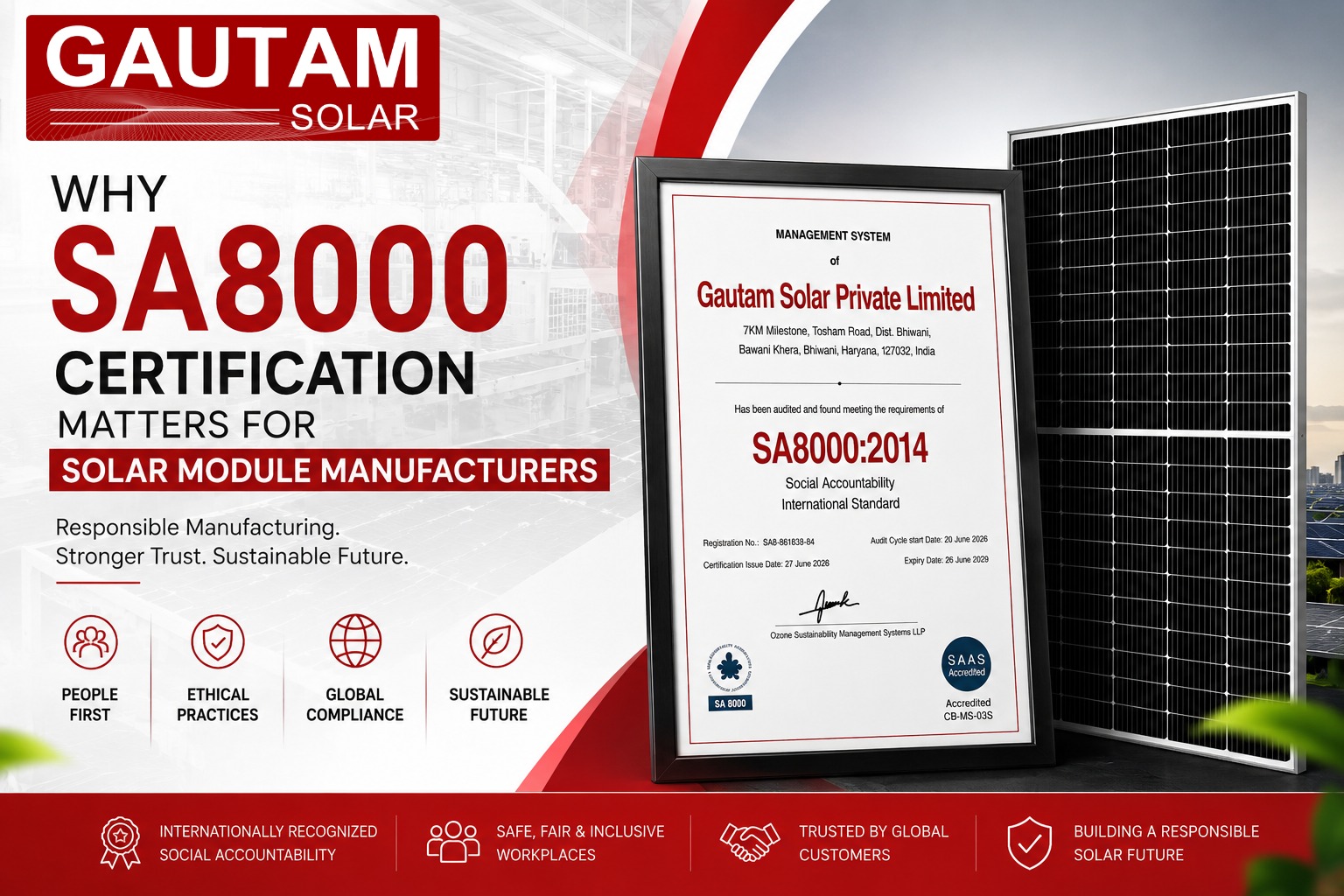
Why SA8000 Certification Matters for Solar Module Manufacturers
IntroductionThe global solar industry is no longer evaluated only on efficiency, technology, and manufacturing capacity. As governments, investors, EPC companies, and corporate buyers strengthen their environmental, social, and governance (ESG) expectations, responsible manufacturing has become a key differentiator. Today, customers want confidence that the products they purchase are manufactured ethically, with respect for workers' rights, workplace safety, and fair labour practices. This shift has increased the importance of SA8000, one of the world's leading social accountability standards. While SA8000 is not mandatory, it demonstrates that a manufacturer follows internationally recognised practices for employee welfare and ethical business conduct, helping build trust across global supply chains.
What is SA8000?
SA8000 is an internationally recognised social certification standard developed by Social Accountability International (SAI). It provides a framework for organisations to establish and maintain fair working conditions based on international human rights principles and International Labour Organisation (ILO) conventions. The standard covers child labour, forced labour, health and safety, freedom of association, discrimination, disciplinary practices, working hours, remuneration, and management systems.
Why It Matters for Solar Manufacturers
Solar energy is promoted as a clean and sustainable source of power. However, sustainability is incomplete if the manufacturing process ignores worker welfare or ethical sourcing. As the industry expands globally, buyers increasingly assess not only product quality but also the values and practices of the companies behind those products. SA8000 helps manufacturers demonstrate that sustainability includes people as well as the environment.
Supporting Global Supply Chains
Large developers, multinational corporations, and public procurement agencies increasingly include ESG and social compliance requirements in supplier qualification. A manufacturer with SA8000 certification provides additional assurance that internationally accepted labour standards are embedded in daily operations. This can strengthen credibility during supplier evaluations and support participation in global supply chains.
Benefits for Manufacturers
Implementing SA8000 encourages organisations to establish structured HR policies, improve occupational health and safety, strengthen employee engagement, reduce workplace risks, and build a culture of continuous improvement. These improvements can enhance productivity, lower employee turnover, and strengthen long-term business resilience while reinforcing the company's reputation as a responsible manufacturer.
Benefits for Customers
Customers benefit by partnering with manufacturers that place equal emphasis on product quality and responsible business practices. EPC contractors, distributors, investors, and corporate buyers can reduce supply chain risks, strengthen ESG reporting, and demonstrate responsible procurement by sourcing from socially accountable manufacturers.
SA8000 and ESG
Environmental sustainability and social responsibility are complementary. While certifications related to product quality, performance, or environmental management address technical and environmental aspects, SA8000 focuses specifically on the human side of manufacturing. Together, these standards help create a balanced ESG strategy that supports responsible long-term growth.
Gautam Solar's Commitment
At Gautam Solar, responsible manufacturing is viewed as an essential part of long-term business excellence. Achieving SA8000 certification reflects the company's commitment to maintaining a safe, ethical, and inclusive workplace while supporting international best practices in social accountability. Combined with investments in advanced manufacturing, quality assurance, sustainability initiatives, and global compliance, SA8000 strengthens Gautam Solar's vision of delivering reliable solar solutions backed by responsible operations.
Looking Ahead
As global energy markets continue their transition toward sustainability, responsible manufacturing will become an increasingly important competitive advantage. Buyers will continue to evaluate how products are made, not just how they perform. Organizations that invest in ethical labour practices, employee welfare, and transparent management systems will be better positioned to earn customer trust and build resilient international partnerships.
Conclusion
SA8000 is more than a certification—it is a commitment to people, accountability, and continuous improvement. For solar manufacturers, it demonstrates that clean energy should be produced through equally responsible manufacturing practices. As ESG expectations continue to evolve, companies that combine technological excellence with strong social responsibility will be better prepared to compete in domestic and international markets. By embracing globally recognised standards such as SA8000, manufacturers can contribute to a more sustainable, ethical, and resilient solar industry.
Frequently Asked Questions
Is SA8000 mandatory
for solar manufacturers?
No. It is a voluntary certification, but global customers and procurement teams increasingly value it.
Does SA8000 certify
product quality?
No. It evaluates social accountability and workplace practices rather than
product performance.
Why is SA8000
important for ESG?
It strengthens the Social pillar of ESG by promoting fair labour practices,
worker welfare, and ethical management systems.
Can SA8000 improve
customer confidence?
Yes. It demonstrates a commitment to internationally recognised labour
standards and responsible manufacturing.