TOPCon vs Mono PERC Solar Panels: Technology, Efficiency and Performance Compared
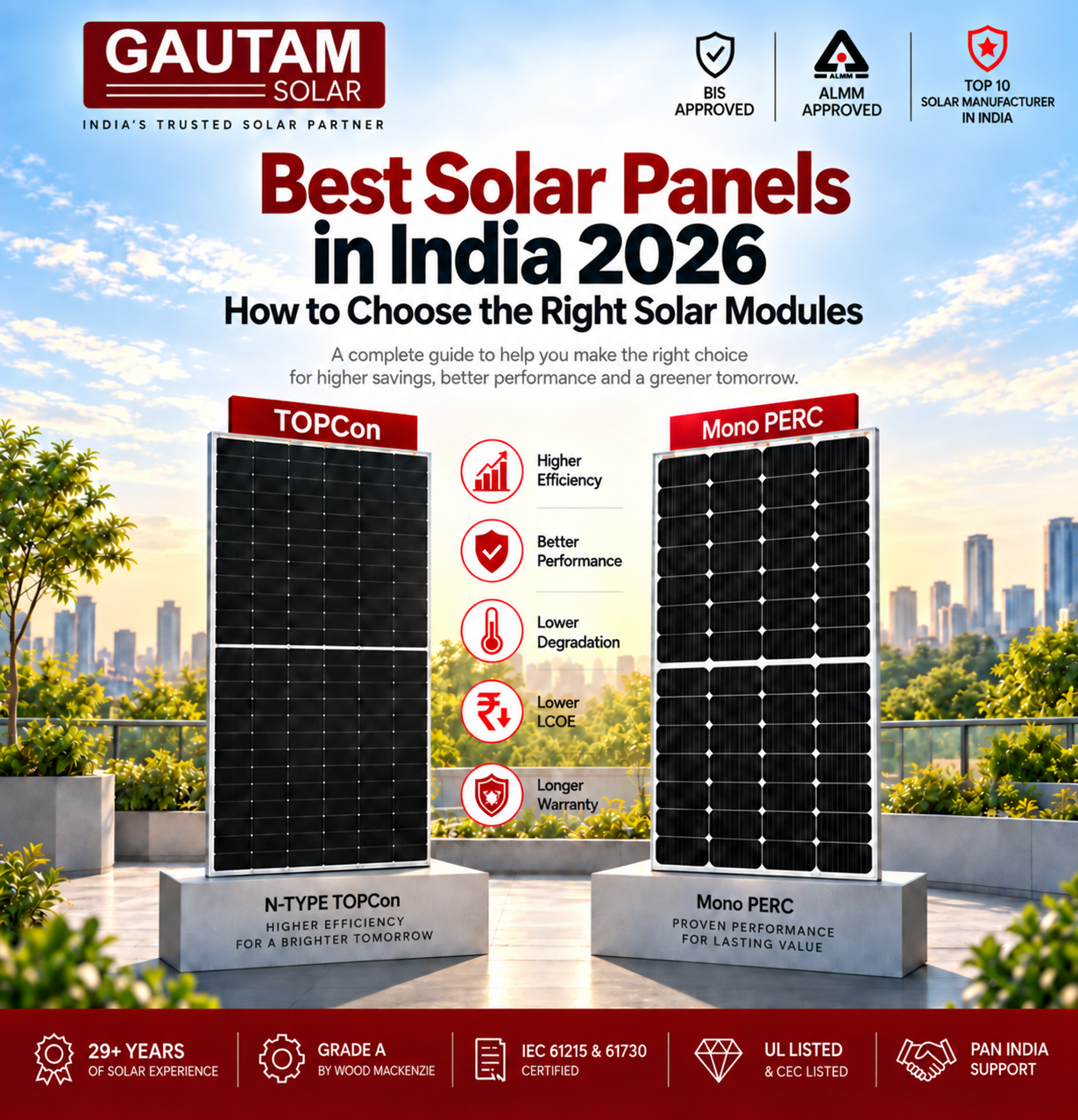
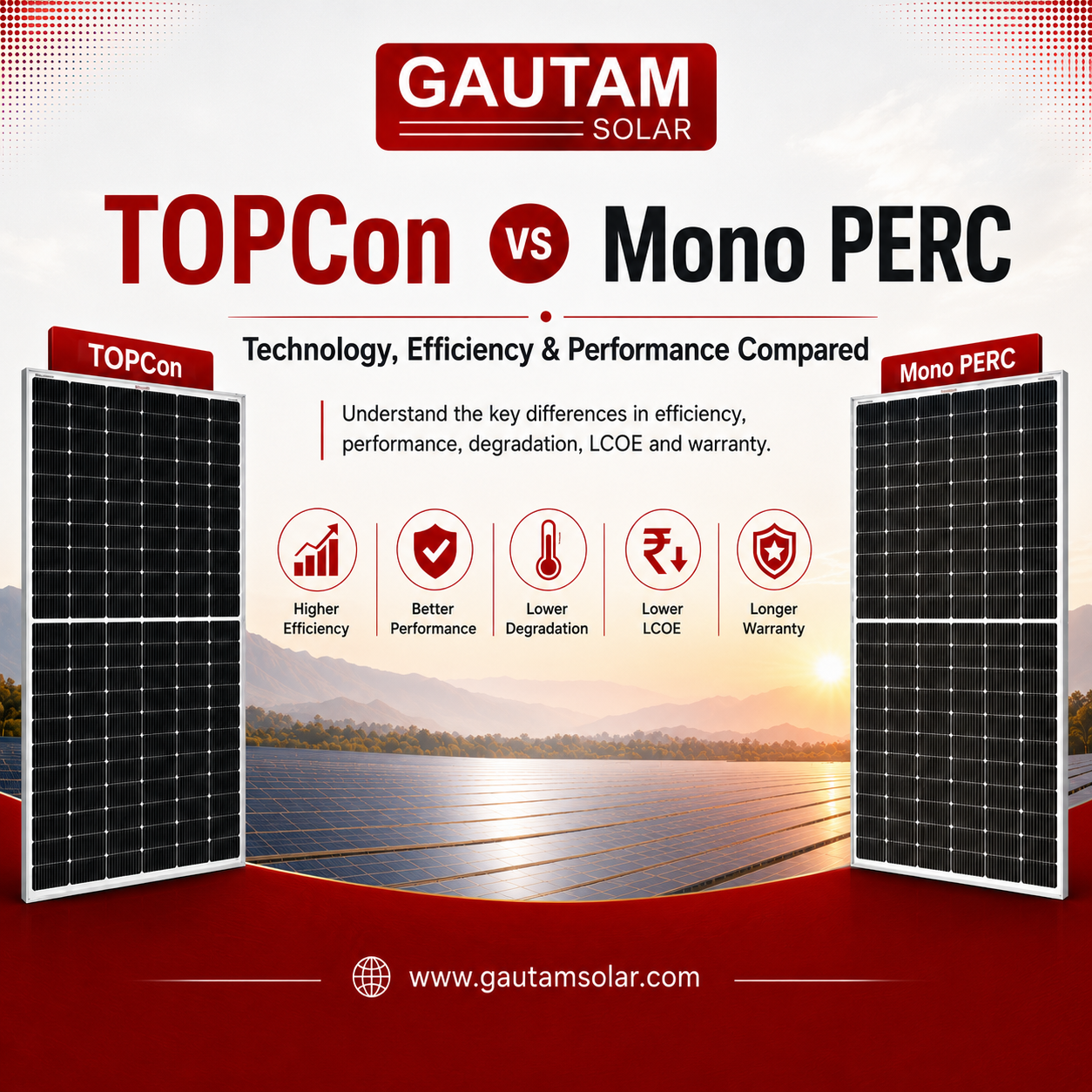
Solar panel technology continues to evolve as manufacturers focus on higher efficiency, better energy generation and improved long-term performance. Two important technologies used in modern solar modules are N-Type TOPCon and Mono PERC.
Both are based on monocrystalline silicon, but their cell structures are different. These differences influence module efficiency, degradation, temperature performance, bifacial capability and lifetime energy generation.
Understanding these differences can help homeowners, businesses, EPC companies and solar project developers select modules according to their project requirements.
TOPCon vs Mono PERC: Quick Comparison
|
Feature |
N-Type
TOPCon |
Mono PERC |
|
Cell Type |
N-Type Silicon |
P-Type Silicon |
|
Technology |
Tunnel Oxide Passivated Contact |
Passivated Emitter and Rear Cell |
|
Efficiency |
Generally Higher |
Good |
|
Degradation |
Generally Lower |
Higher than N-Type TOPCon |
|
Temperature Performance |
Better |
Good |
|
Bifacial Capability |
Strong |
Available in selected designs |
|
Long-Term Energy Yield |
Generally Higher |
Proven Performance |
|
Technology Stage |
Advanced-generation technology |
Mature and widely deployed |
What Is Mono PERC Technology?
Mono PERC stands for Monocrystalline Passivated Emitter and Rear Cell.
PERC technology uses a passivation layer on the rear side of a monocrystalline solar cell. This helps reduce energy losses and improves the cell's ability to convert sunlight into electricity.
Mono PERC became widely adopted because of its combination of reliable performance, established manufacturing processes and competitive project economics.
It has been extensively used in:
• Residential rooftop systems
• Commercial and industrial solar projects
• Ground-mounted plants
• Utility-scale installations
This makes Mono PERC a mature and proven solar technology.
What Is N-Type TOPCon Technology?
TOPCon stands for Tunnel Oxide Passivated Contact.
TOPCon solar cells use a thin tunnel oxide layer and a passivated contact structure designed to reduce electrical losses within the cell.
Modern TOPCon modules generally use N-Type silicon, which offers advantages such as lower degradation and high conversion efficiency.
These characteristics have made N-Type TOPCon increasingly popular for high-efficiency solar modules used across residential, commercial, industrial and utility-scale projects.
TOPCon vs Mono PERC: Key Differences
1. Solar Panel Efficiency
One of the major differences between TOPCon and Mono PERC is module efficiency.
Modern N-Type TOPCon solar panels generally achieve higher efficiency than traditional Mono PERC panels.
Higher efficiency means more solar capacity can potentially be installed within the same available area.
This is particularly useful for:
• Factory rooftops
• Warehouses
• Commercial buildings
• Residential rooftops
• Space-constrained solar projects
For projects where installation area is limited, higher module efficiency can therefore be an important advantage.
2. Degradation and Long-Term Performance
Solar modules gradually lose a small percentage of their generating capacity over time. This is known as degradation.
N-Type TOPCon technology generally has lower degradation compared with traditional P-Type Mono PERC technology.
Lower degradation helps a module retain more of its original output over its operating life, which can contribute to higher lifetime energy generation.
When comparing specific modules, buyers should always check the manufacturer's degradation specifications and performance warranty.
3. Temperature Performance
Solar module output generally decreases as module temperature increases.
The impact of temperature is measured using the temperature coefficient of maximum power (Pmax).
TOPCon modules can offer favourable temperature characteristics compared with conventional Mono PERC modules. This can be particularly relevant for solar installations in hot climatic conditions such as India.
4. Bifacial Performance
Bifacial solar modules can generate electricity from sunlight reaching both the front and rear sides of the module.
TOPCon technology is well suited to bifacial module designs, making it an attractive option for many ground-mounted and utility-scale installations.
The additional energy generated from the rear side depends on factors including:
• Ground reflectivity
• Module installation height
• Row spacing
• Mounting structure
• Rear-side shading
• Site conditions
Bifacial Mono PERC modules are also available, so bifacial performance should always be evaluated at the individual module level.
5. Long-Term Energy Generation
Solar module selection should not be based only on initial module price.
For long-term solar projects, important factors include:
Efficiency + Degradation + Temperature Performance + Warranty + Lifetime Energy Generation
Higher efficiency combined with lower degradation can help TOPCon modules deliver strong energy-generation performance throughout their operating life.
For large C&I and
utility-scale projects, even relatively small improvements in module
performance can become significant when multiplied across hundreds or thousands
of panels.
Gautam Solar N-Type TOPCon Panels
Gautam Solar offers advanced N-Type TOPCon solar modules for residential, commercial, industrial and utility-scale solar applications.
Its G12 R N-Type TOPCon Series is available in the 620 Wp to 640 Wp range, with module efficiency ranging from 22.95% to 23.69%.
Key features include:
• Up to 640 Wp power output
• Up to 23.69% module efficiency
• Bifacial Glass-to-Glass construction
• Rectangular cell technology
• Bifacial gain of up to 30% under suitable conditions
• High power density
• Improved utilization of available installation area
The higher wattage and efficiency can be particularly useful for projects where maximizing installed capacity from the available space is important.
Applications of Gautam Solar TOPCon Modules
Commercial & Industrial Rooftops: High-efficiency modules can help factories, warehouses and commercial facilities install more solar capacity within available rooftop space.
Ground-Mounted Solar Projects: Bifacial Glass-to-Glass modules can utilize reflected sunlight from the rear side when the project is properly designed.
Utility-Scale Solar Plants: High module efficiency and long-term energy generation can support improved project performance across large installations.
Residential Rooftops: Higher efficiency can help homeowners make better use of limited usable rooftop area.
Gautam Solar Mono PERC Panels
Gautam Solar also offers Mono PERC solar modules, including 540–550 Wp monofacial and bifacial options.
The Mono PERC portfolio incorporates module technologies such as:
• M10 Half-Cut cells
• Multi-Busbar design
• Round Ribbon connectors
• Non-Destructive Cell Cutting
• Monofacial and bifacial configurations
Mono PERC remains suitable for projects where its technical specifications, system design and project economics match the installation requirements.
TOPCon and Mono PERC for Different Solar Projects
The selection between TOPCon and Mono PERC should depend on the requirements of the project rather than the technology name alone.
For a space-constrained rooftop, higher-efficiency TOPCon modules can help increase installed capacity.
For commercial and industrial projects, efficiency, degradation and lifetime energy generation can influence overall project economics.
For ground-mounted and utility-scale projects, bifacial capability, temperature performance, degradation and expected lifetime yield become important considerations.
Mono PERC remains a proven technology, while N-Type TOPCon represents the next generation of high-efficiency crystalline silicon solar technology.
Conclusion
N-Type TOPCon and Mono PERC are both established monocrystalline solar technologies, but their cell architecture and performance characteristics are different.
Mono PERC is a mature and widely deployed technology with a strong track record across residential, commercial and large-scale solar installations.
N-Type TOPCon represents a newer generation of solar cell technology, offering advantages in areas such as higher efficiency, lower degradation, temperature performance, bifacial capability and long-term energy generation.
Gautam Solar offers both technologies, including its advanced G12 R N-Type TOPCon modules with power output up to 640 Wp and module efficiency up to 23.69%, providing solutions for residential, C&I and large-scale solar projects.