Quick Answer
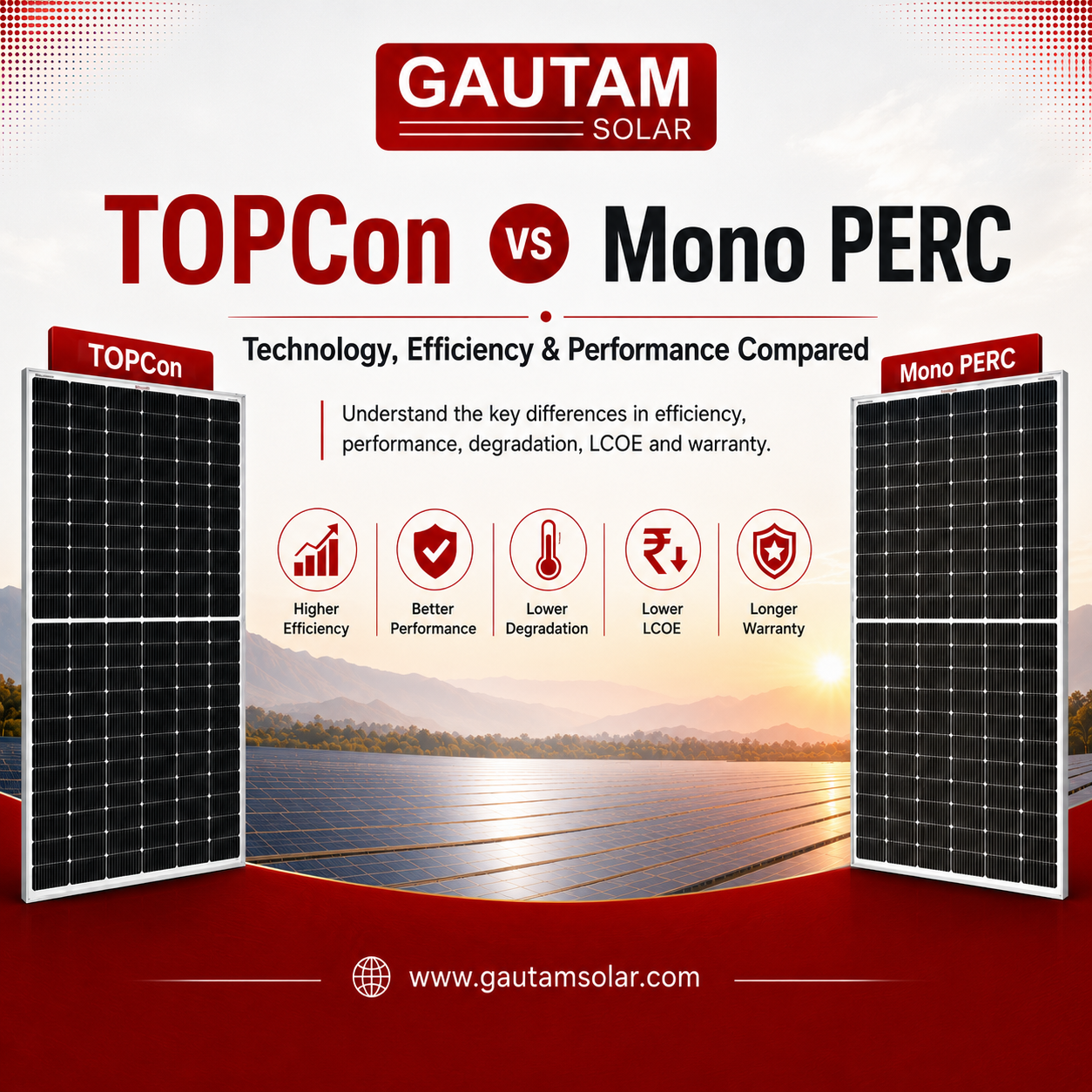
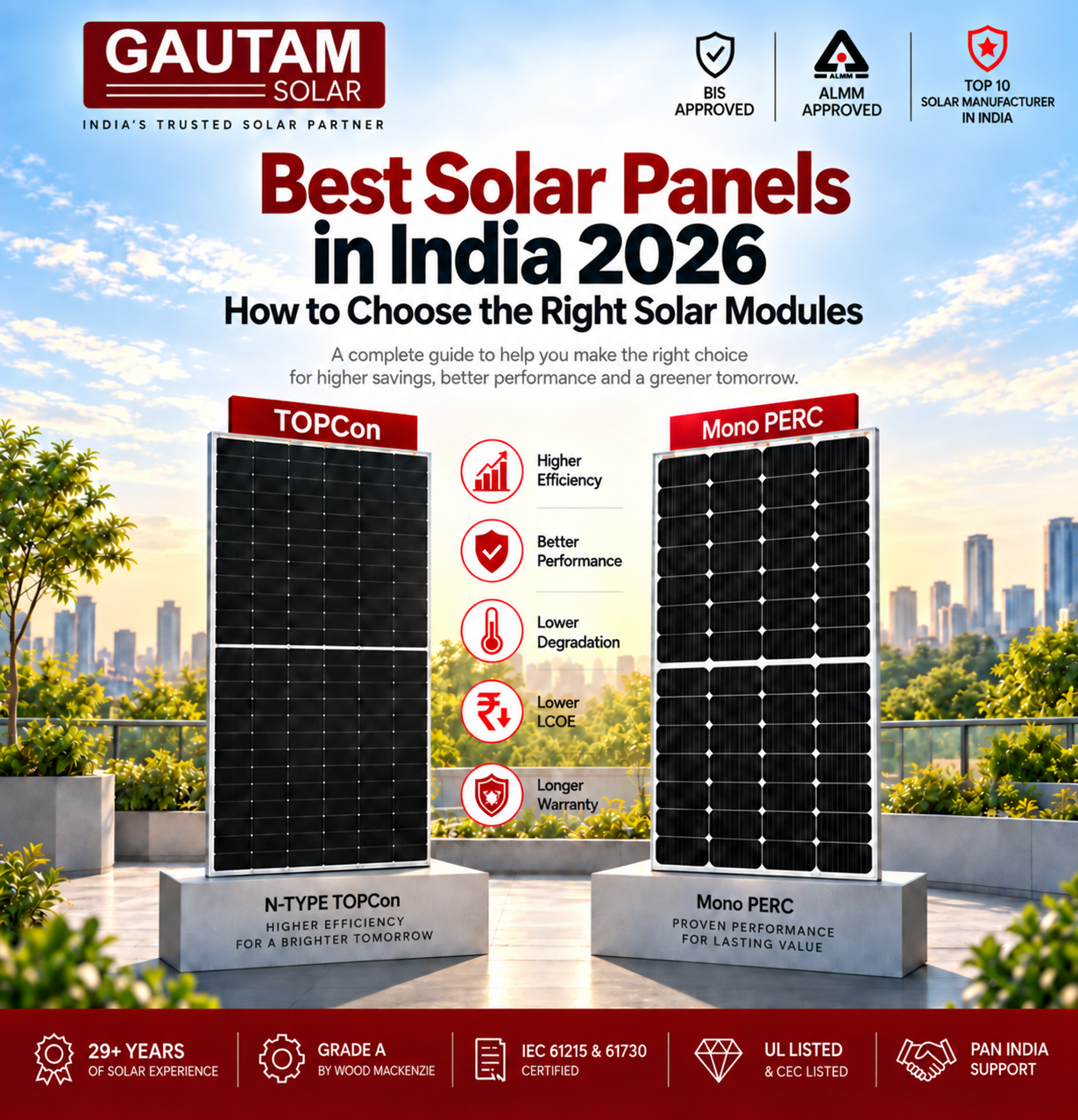
N-Type TOPCon panels are the better choice in 2026 for most new installations — they offer higher efficiency (up to 23.69%), slower degradation (0.4%/year vs 0.55%/year), and a lower long-term cost of energy. Mono PERC is still a smart, budget-friendly option when roof space isn't limited and upfront cost matters most.
Why Solar Panel Technology Matters More in 2026
Solar has moved well past the point where "any panel will do." As module prices have fallen and rooftop space has become the real constraint for many homeowners and businesses, the cell technology inside the panel — not just its wattage — determines how much energy you actually generate over 25+ years. That's why the TOPCon vs Mono PERC decision has become one of the first questions every serious buyer asks.
What Is N-Type TOPCon Technology?
TOPCon stands for Tunnel Oxide Passivated Contact. In this design, a thin tunnelling oxide layer is applied on an N-Type silicon substrate, followed by a layer of highly doped polysilicon and passivated contacts. The oxide layer lets charge carriers pass through while minimising recombination losses, and the passivated contacts reduce surface recombination — together delivering higher power and efficiency than older cell designs. You can see the full technical range on our N-Type TOPCon Solar Modules page.
The core difference starts at the doping stage. In P-type cells (used in conventional Mono PERC), the base silicon layer is doped with boron, creating a dominance of positive charge carriers. In N-type cells, the base layer is doped with phosphorus instead, generating free electrons — which is what gives TOPCon its efficiency edge.
What Makes TOPCon Modules Perform Better
• N-type cell structure for higher efficiency and better low-light response
• 144 half-cut cells using Non-Destructive Cell Cutting (NDC), which avoids heat-affected zones and lowers the risk of micro-cracks
• Multi-busbar design to cut electrical losses
• Round ribbon connectors (vs flat ribbon) that reflect and reuse light falling on the ribbon itself — up to 70% of that light is converted, compared to just 5–10% with flat ribbon
• Bigger M10 cells for higher wattage per module
• Excellent anti-PID performance and availability in both monofacial and bifacial formats
Lower Degradation, Longer Life
This is where TOPCon really separates itself. N-type TOPCon modules degrade around 1% in the first year and 0.4% year-on-year after that, compared to roughly 2% in year one and 0.55% annually for standard P-type modules. Over a system's lifetime, that means TOPCon modules retain about 87.4% of rated output after 30 years, versus P-type modules dropping to around 84.8% after just 25 years.
The Financial Upside
Beyond raw efficiency, TOPCon's higher power density translates directly into savings: roughly 3.26% lower Balance-of-System (BOS) costs and a 1.56% reduction in LCOE (Levelised Cost of Energy) — because fewer panels are needed to hit the same capacity, which means less mounting structure, wiring, and installation labour per kilowatt.
Gautam Solar's N-Type TOPCon range spans from 580–600 Wp bifacial modules up to the R-Series 620–640 Wp rectangular bifacial modules, with efficiencies reaching up to 23.69%. Full specifications and datasheets are available on the N-Type TOPCon Solar Modules page.
What Is Mono PERC Technology?
Mono PERC (Passivated Emitter and Rear Cell) has been the industry's dependable workhorse for years, and it's still a smart choice for many projects. It adds a passivation layer to the rear of a standard monocrystalline cell, reducing electron recombination and improving how much sunlight the cell converts into usable energy. See the current range on our Mono PERC Solar Modules page.
What Makes Mono PERC Modules Perform Well
• Round ribbon connectors (0.35 mm diameter, versus 0.9 mm flat ribbon) that reduce shading on the cell surface, adding up to 2.5% more power
• Half-cut cells via Non-Destructive Cell Cutting, using a low-temperature laser process (under 130°C) to minimise micro-crack risk
• Multi-busbar structure for lower electrical losses
• Bigger M10 cells for higher wattage
• Available in 144 or 120 half-cut cell configurations, monofacial and bifacial
• All-black and silver frame options for a cleaner rooftop look
• Built to withstand extreme weather, with strong anti-PID performance
Mono PERC remains a versatile fit across utility, commercial & industrial (C&I), and residential rooftop installations — particularly where the installed cost per watt matters more than squeezing maximum output from limited space.
How Are TOPCon and Mono PERC Cells Manufactured?
The manufacturing difference is what drives the price and performance gap between the two technologies.
Mono PERC: Built on standard monocrystalline cell production, with a dielectric passivation layer deposited on the rear side and then laser-patterned to open contact points. It's a well-established, lower-complexity process, which is a big reason Mono PERC modules cost less to produce.
N-Type TOPCon: Adds extra steps on top of a PERC-style line — an ultra-thin tunnel oxide layer is deposited on the rear surface, followed by a phosphorus-doped polysilicon layer. This additional deposition step is more complex and equipment-intensive, which is why TOPCon modules typically carry a modest price premium per watt over Mono PERC — a premium that's increasingly offset by TOPCon's efficiency and degradation advantage over the system's lifetime.
TOPCon vs Mono PERC: Side-by-Side
|
Factor |
N-Type TOPCon |
Mono PERC |
|
Cell type |
N-type (phosphorus-doped) |
P-type (boron-doped) |
|
Efficiency |
Higher — up to 23.69% |
Slightly lower, but still strong |
|
First-year degradation |
~1% |
~2% |
|
Annual degradation after year 1 |
~0.4% |
~0.55% |
|
Power retained after 25–30 years |
~87.4% (after 30 yrs) |
~84.8% (after 25 yrs) |
|
BOS cost impact |
~3.26% savings |
Standard |
|
LCOE impact |
~1.56% reduction |
Standard |
|
Panel price per watt |
Slightly higher upfront |
Lower upfront |
|
Best suited for |
Limited roof space, long-term yield priority |
Cost-sensitive projects with sufficient roof area |
Cost vs Value: Which Panel Gives Better Return?
On a pure price-per-watt basis, Mono PERC modules are usually the cheaper option upfront, since the manufacturing process involves fewer steps. TOPCon modules typically cost a bit more per watt to buy — but that gap narrows once you account for the full system economics:
• Fewer TOPCon panels are needed to hit the same capacity, cutting mounting structure, cabling, and installation costs (the ~3.26% BOS savings)
• Lower degradation means TOPCon systems generate more energy in year 15, 20, and 25 than a same-capacity Mono PERC system
• The combined effect is a lower cost per unit of energy produced over the system's life (the ~1.56% LCOE reduction), even with a higher panel price
For an exact price-per-watt comparison for your project size, get in touch with our team for a current quote — pricing shifts with silicon costs and order volume, so it's worth checking live numbers rather than relying on general estimates.
Which Panel Fits Your Project? Real-World Scenarios
Residential Rooftop (3–10 kW)
Urban rooftops are usually the tightest on space. TOPCon's higher power density means you can hit your target capacity with fewer panels — useful when you're working around water tanks, shadows, or a small usable roof area.
Commercial & Industrial (C&I) Rooftop
C&I roofs often have more space than a home, but land value and roof load limits still matter. Here the choice depends on your payback-period target: Mono PERC if you're optimising for the lowest upfront capex, TOPCon if you want to maximise output per square metre of leased or owned roof.
Utility-Scale Ground-Mount
When land isn't a constraint, Mono PERC can still deliver strong project economics. But in high land-cost regions, or projects targeting the lowest possible LCOE for a PPA, TOPCon's yield advantage compounds across thousands of panels. See our Solar Power Plant solutions for utility and ground-mount options.
Which One Should You Choose?
There's no universal winner — it comes down to your project's priorities:
Choose N-Type TOPCon if:
• You have limited roof or land area and need to maximise power density
• You're planning a long-term investment where lower degradation compounds into meaningfully more energy over 25–30 years
• You want the lowest achievable LCOE for a large-scale ground-mounted or C&I project
Choose Mono PERC if:
• Roof space is not a constraint and you want to optimise upfront cost
• You need a proven, widely available technology with a strong performance track record
• You're running a budget-conscious residential or small commercial installation
Both technologies, when sourced from a certified manufacturer, deliver reliable long-term performance — the decision is really about matching the panel to your site and your financial priorities, not just picking whichever one sounds newer.
Why It Matters Who You Buy From
Panel technology is only half the equation — manufacturing quality decides whether a module actually performs to its datasheet for 25+ years. Look for:
• BIS approval (mandatory for solar modules sold in India)
• ALMM (Approved List of Models and Manufacturers) listing, required for most government and subsidy-linked projects
• A manufacturer with proven manufacturing scale and dedicated cell production, rather than only module assembly
• Established industry experience and track record
Gautam Solar has over 29 years of solar industry experience, a 5.2 GW manufacturing capacity, and a 3 GW cell plant in Madhya Pradesh — backing both its TOPCon and Mono PERC ranges with BIS and ALMM approval. See our full Quality Certificates for details.
Final Word
Whether you go with N-Type TOPCon for maximum efficiency and long-term yield, or Mono PERC for proven, cost-effective performance, the right choice is the one that matches your roof space, budget, and energy goals. Talk to our team for site-specific numbers before deciding — the panel that wins on a datasheet isn't always the panel that wins on your rooftop.